News for January 2025!
What happened in January 2025 at Phyto-info… we tell you everything!
Hello everyone 🌿
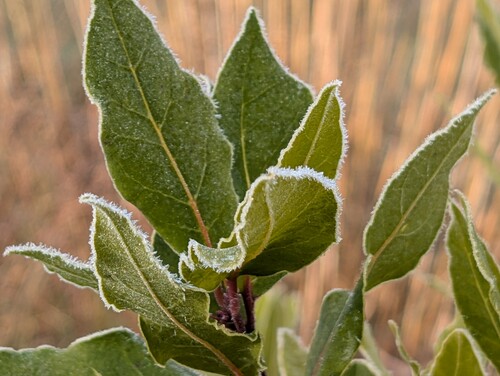
We all have in mind this somewhat clichéd image of Julius Caesar, crowned with a laurel braid, triumphant and radiant with glory on his chariot while greeting the jubilant crowd. The laurel, the plant of the victors, but not only… it is also the plant of scientists. In the Middle Ages, on the day of the awarding of university degrees, freshly graduated students proudly wore their laurel berries… or in Latin baca laurea 🤯
Now reduced to a simple culinary role for its aroma, the laurel has lost its former splendour. However, it is the one that helps us digest a heavy dish. It is also antiseptic, diuretic, stomachic, expectorant, to name a few of its properties. Be careful, we are talking here about the cooking bay leaf that is added to the roast, not the one that serves as a privacy screen, the latter being toxic or even deadly depending on the species. So let’s stay careful!
Bay laurel infused oil 👏
Discover a way to make your own bay leaf infused oil. We tested this recipe, it’s relatively easy and we get by for less than 10 euros of ingredients. And what is the point of an infused oil of bay laurel? It is used to relieve our joint pain and that of our pets; Find the detailed recipe on our blog. To your pots and pans 🥰
Update 👏
- Bay laurel (Laurus nobilis)
(Re)discover its multiple applications on our platform.
Added plants 👏
We have been asked for chamomile, and we are working on it. Discover the different chamomiles soon, because there is not only evening chamomile. We also have the Roman, the big one, the one from the fields, the stinking one (yes yes) and the one that smells nothing. A big job in perspective… not even afraid 😉
Improvement 👏
The list of biochemical compounds has been improved by merging the categories Bitter Principles and Sesquiterpene lactones, both designating the same thing. Although the term Bitter Principles was commonly used in ancient works, it is now a little old-fashioned and it is preferable to use the more modern term of Sesquiterpene lactones.
Sesquiterpene lactones play a key role in plant defense and are of therapeutic interest to humans.
And for those who would like to know more, sesquiterpene lactones, belonging to the terpene family, combine a 15-carbon sesquiterpene backbone made up of three isoprene units and a lactone ring, namely a cyclic ester. They are generally found in Asteraceae. Sesquiterpene lactone plants can be, among others, anti-infectious, antiparasitic, antibacterial, antifungal, mucolytic, expectorant, diuretic, and/or anti-migraine. To find out which plants are impacted by this change, visit our updates.
🌿 🌻 🌾
This was the news of our month of January, if you are interested in our search tool, more info on phyto-info.com.
To discover our plant finder, head to this page.
And if you have any questions, please do not hesitate to contact us 🤗
Next newsletter in a month! Stay tuned!