News from May 2025!
What happened in May 2025 at Phyto-info… we tell you everything!
Hello everyone 🌿
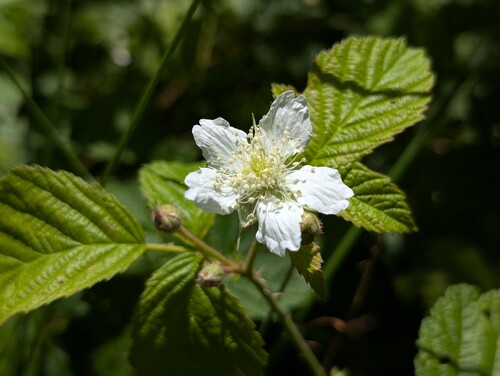
The cradle of the oak is made of brambles.
Often considered a nuisance, the bramble nevertheless has a mission to accomplish: it prevents grazers from attacking baby trees in general and baby oaks in particular, giving them a good head start. And as soon as these teenagers are strong enough to resist the hungry jaws of the leaf eaters, our forest godmother simply withdraws to go and settle elsewhere, where she will be needed. It’s still beautiful 🥰
Yet, who hasn’t ever cursed a bramble bush that colonizes everything in the garden at an incredible speed? No matter what you call it, the bramble, whose scientific name is Rubus fruticosus, is not the enemy, quite the contrary. Okay, it’s true that she doesn’t play nice with her thorns, but let’s be honest, she provides us with some pretty great services on a daily basis.
We’re not going to reveal everything now, we’ll let you discover all its secrets on our platform. But we’re willing to bet you’ll never look at a bramble the same way again 🤗
Plant updated 👏
- Black Bramble (Rubus fruticosus)
Rediscover its benefits and precautions for use on our platform.
New preparation 👏
Glycerinated macerate is now part of the preparations in our plant fact sheets, just like infusion, decoction, tincture, syrup or poultice.
What is a glycerine macerate?
Glycerinated macerate, also called bud macerate, is a liquid preparation used in gemmotherapy. This preparation is quite simple to make yourself at home.
In short, to make a glycerine macerate, fresh buds of certain plants are harvested and soaked in a mixture of water, alcohol and glycerin. This winning trio will extract all the concentrated benefits from the buds, which contain all the future properties of the adult plant. More specifically, with water we recover, for example, tannins, mineral salts, water-soluble flavonoids and vitamins; with alcohol, it will be alkaloids, phenolic acids, other flavonoids and vitamins; and with glycerin, we will capture volatile oils, phenolic acids, fat-soluble flavonoids and vitamins, waxes, gums… You will find the explanations on the relevant plant sheets.
Since the glycerinated macerate is taken in drops, a blue dropper will be used for the pictogram.
New book 👏
We have just acquired the first edition of Kunzle’s Medical Guide, an “old” book from 1950 written by the priest and herbalist Jean Kunzle and published by Otto Walter SA. Olte.
Frankly, we’re a little disappointed; the content doesn’t meet our expectations. We would have liked more in-depth monographs and explanations; this will teach us to pick up a book without leafing through it. Even if we don’t use it as a reference for our plant fact sheets, we are still happy to enrich our library with a book that caused a sensation in its time and left its mark on its era.
Kunzle, J. (1950). L’art de guérir: le Kunzlé médical. Éditions Otto Walter S.A. Olten.
New illustrations 👏
A big thank you to Hélène from the Atelier P’tites Boussoles for the new illustrations. We added the verbenas, the white, the blue, the lemongrass, the officinale and the sweet, and the last two, the true oxlip and the field primrose.
🌿 🌻 🌾
This was the news of our month of April, if you are interested in our search tool, more info on phyto-info.com.
To discover our plant finder, head to this page.
And if you have any questions, please do not hesitate to contact us 🤗
Next newsletter in a month! Stay tuned!