News from August 2025!
What happened in August 2025 at Phyto-info… we tell you everything!
Hello everyone 🌿
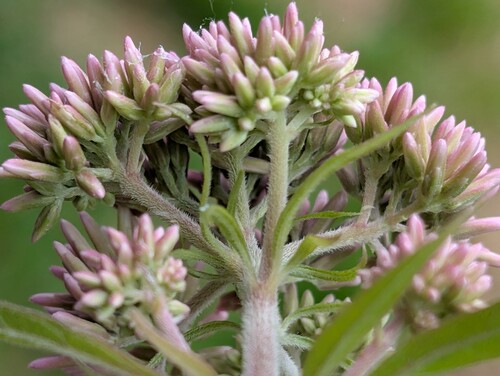
At the moment, it’s the only thing you see near wetlands, the hemp agrimony with its small pinkish-purple flowers in terminal clusters. Before it was known that one of its main constituents was a pyrrolizidine alkaloid, potentially toxic to the liver, it was used freely for viral problems and immune deficiencies, and with success. But that was before, now we know…
It should also be noted that the fresh leaves of hemp agrimony are equally known for their healing properties; injured deer rub themselves on them to heal. But we’re not deer and while fresh leaves can help heal wounds, they also contain a very toxic alcohol, tremetol, which is problematic if ingested. Fortunately, this alcohol disappears completely when the leaves are dried.
Animals are not exempt; tremetol is also toxic to them. In the 19th century, European settlers in the United States suffered from a mysterious disease, as did their livestock. People who drank milk from contaminated cows developed a serious, often fatal illness characterized by intense thirst, vomiting, and general weakness, known as “toxic milk disease”. It took a while to realize that the culprit was the tremetol contained in rough eupatorium, the same tremetol also found in hemp agrimony 😳
In conclusion, hemp agrimony, if there is no other choice of plants, must be used very dry for a very short period and with extreme caution.
New plants 👏
- Hemp agrimony (Eupatorium cannabinum)
- Boneset (Eupatorium perfoliatum)
- Gravel root (Eutrochium purpureum)
Read the instructions and precautions for using these plants on our platform.
Our upcoming workshops 👏
It’s decided! The workshops will resume in November. We are preparing the new flyer and will update our website very soon with the full description of each workshop.
The workshops will be held every second Sunday of the month, from 1 p.m. to 3 p.m. To guarantee your place, remember to register, as we limit groups to a maximum of 4 participants.
Member price: 10 euros - Non-member price: 30 euros
Workshop themes
- Vinegar and oxymel workshop (November)
- Plant syrup workshop (December)
- Workshop on infused oils and ointments (January)
- Infusions and decoctions workshop (February)
- Workshop on powders, capsules and tablets (March)
- Tincture, wine and elixir workshop (April)
More info next month!
Medicinal plants are sometimes used in cooking… 👏
We visited the edible forest of Hennezel, a one-hectare plot managed by the OAZO non-profit organization. This nourishing paradise is home to no less than 500 plant species… a true exploration with unexpected flavors. To learn more about this incredible biodiversity, read the story of our experience.
Our two favorite books 👏
It’s finally here! We had wanted to acquire the Wichtl and Anton for a long time despite its price. It is now one of our essential references and we are delighted about it.
Wichtl, M., & Anton, R. (2003). Plantes thérapeutiques: tradition, pratique officinale, science et thérapeutique (2e éd.). Editions TEC & DOC.
We also got our hands on another reference work in English, that of Maud Grieve. Sophia Emma Magdalene Grieve, also known as Maud or Margaret, was a renowned and highly influential herbalist in her time, playing a key role in the rehabilitation of herbal medicine in Great Britain at the beginning of the 20th century.
Grieve, M. (1931). A modern herbal: the medicinal, culinary, cosmetic, and economic properties, cultivation, and folklore of herbs, grasses, fungi, shrubs, and trees with all their modern scientific uses. Tiger Books International.
🌿 🌻 🌾
This was the news of our month of August, if you are interested in our search tool, more info on phyto-info.com.
To discover our plant finder, head to this page.
And if you have any questions, please do not hesitate to contact us 🤗
Next newsletter in a month! Stay tuned!