Teaching medicinal plants in schools: a utopia?
Faced with post-World War I shortages, a French educator designed a school manual to teach children how to recognize and harvest medicinal plants, while integrating them into traditional learning.
Let’s imagine a world where teachers teach children about the world of plants and their benefits, just as they teach them about language or mathematics.
Let’s imagine a teaching tool where plants would be used as a medium to discover essential concepts. Well, that tool exists, or at least it did.
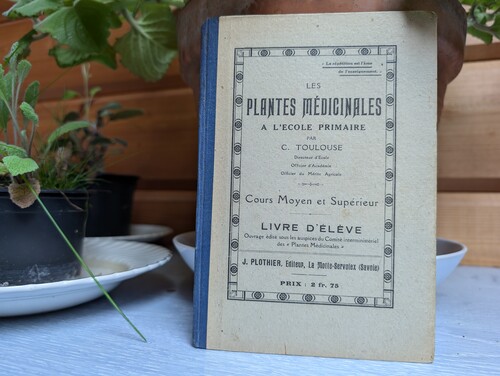
As a school principal, academic officer and agricultural merit officer, Mr. Toulouse undertook the writing of an educational work to teach medicinal plants to children in middle and upper primary school.
Uh… what’s the upper primary school?
Upper primary education is an order of education that existed in France between 1833 and 1941. Yes, we know, it’s not from yesterday and we’re talking about elementary school here, the target being teenagers in the making.
And why are we talking about teenagers in the making?
In the aftermath of the hostilities of the Great War, the French had the very unpleasant surprise of being dependent abroad for the supply of their medicinal plants. For example, lime came from Austria, walnut leaves and cherry tails from Italy, not to mention pharmaceuticals that came from Germany. Already at that time, the importance of health sovereignty was on everyone’s lips.
In order to compensate for the deficiencies caused, as a reminder, it was 1920, a cry of solidarity invited everyone, from the youngest to the oldest, to contribute to the collective effort by harvesting medicinal plants.
Let’s get back to our budding teenagers… Mr. Toulouse’s idea was to encourage primary school students to go and collect plants to supply local pharmacies that were in short supply, while giving them the tools they needed for the task.
In this student book you can find activities such as problems, dictations, French compositions, handicrafts, and many others, all arranged around medicinal plants. Here, we even learn how to make cardboard boxes for transporting crops. And the icing on the cake, at the end of the book, you can find the market value of the collected plants.
A school with 38 pupils sold 28 kil in one year. 7 violets at a rate of 5 fr. 20 per kilo, 12 kil. 5 white broth flowers at 6 fr. 50 per kilo, 8 kil. 2 chamomile flowers at 5 fr. per kilo, 30 kil. 5 of seson leaves with 1 fr. 25, 42 kil. of serpolet and as much thyme at 0 fr. 90. The proceeds of this sale are divided equally among the collectors, after taking 30% for various good works. How much will each student receive?
In addition to knowledge about plants, the values conveyed by this student book were respect for nature and solidarity. A whole program!
To discover our plant finder, head to this page.
If you are interested in our search tool, more info at phyto-info.com
And if you have any questions, please do not hesitate to contact us 🤗